


Why Traditional Direct Response Marketing Is Losing Its Edge


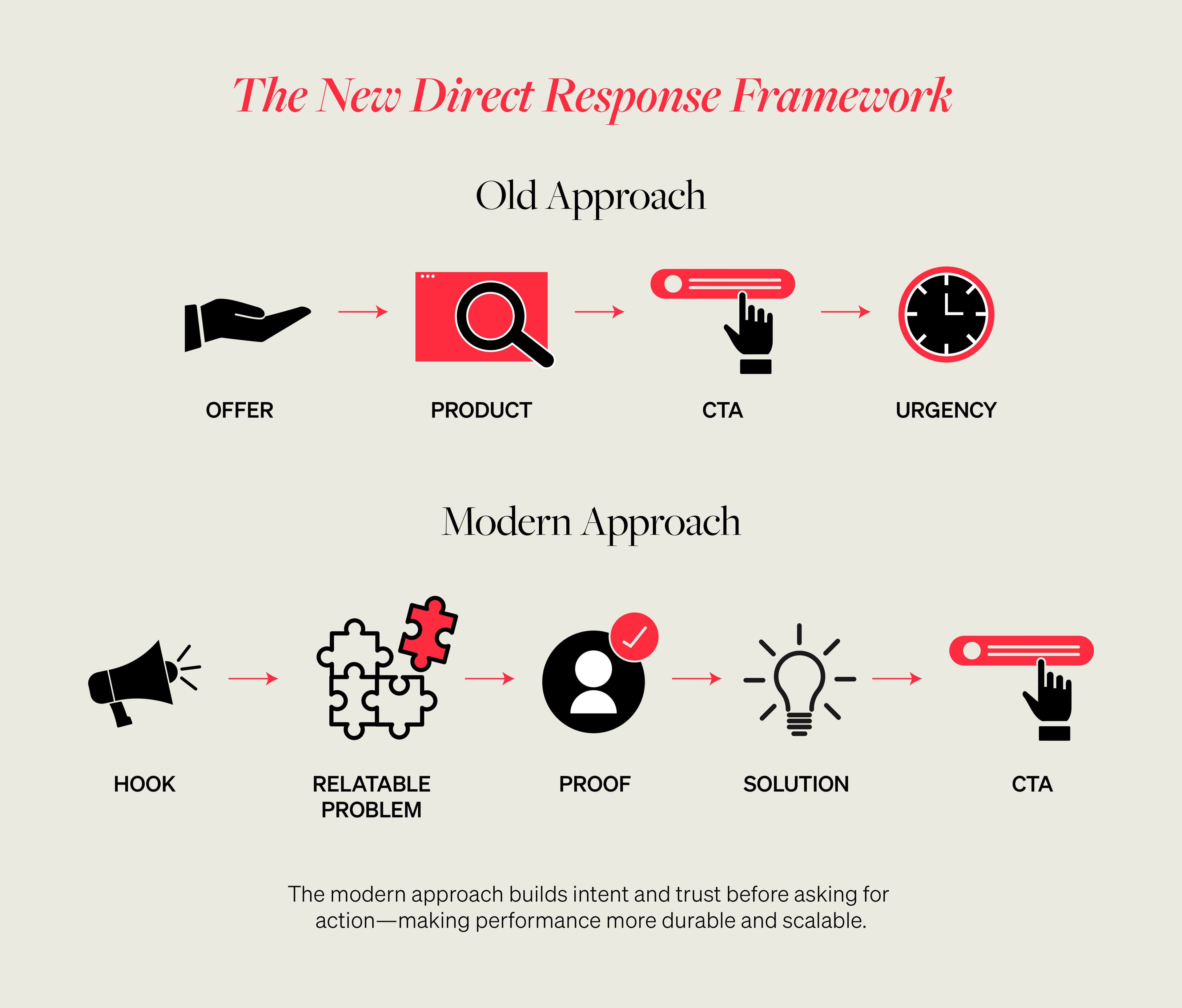
For years, direct response marketing followed a simple formula: offer + urgency + call to action.
And for a long time, it worked.
Today, that approach still exists—but it no longer delivers the automatic performance advantage many brands expect. The issue isn’t that direct response is broken. It’s that the environment changed faster than the playbook.
Consumers now have more control, more skepticism, and less attention than ever before. Platforms reward engagement, not interruption. And trust has become a prerequisite for conversion—not a separate brand objective.
TL;DR — Why Direct Response Is Losing Its Edge
- Audiences recognize and skip salesy ads
- Attention spans are shorter
- Algorithms reward engagement, not interruption
- Trust is now a conversion factor
- Brand multiplies performance efficiency
People recognize ads instantly.
Audiences have developed strong “ad literacy.” When creative feels overly sales-driven, it’s filtered out in seconds.
Attention is scarce—and earned.
Direct response assumes time to explain the offer, product, and benefit. In reality, brands often get less than a second to prove relevance.
Algorithms prioritize engagement, not clicks.
Creative that generates low-quality engagement—even if it drives clicks—gets penalized over time, increasing costs and reducing reach.
Trust is now part of performance.
Urgency without credibility triggers resistance. Social proof, authenticity, and validation now directly impact conversion.
Measurement has changed.
With weaker attribution signals, click-only optimization often undervalues awareness and misreads what actually drives demand.
The feed isn’t a storefront—it’s a content stream.
People aren’t browsing to buy; they’re browsing for stimulation. That means ads must behave like content before they behave like marketing. Scroll-stopping creative isn’t louder—it’s more relevant, more human, and more intentional.
When brands earn attention first, performance improves:
- Lower CPMs
- Higher watch time
- Stronger recall
- Better conversion efficiency
The old model separated brand and performance. The modern reality blends them.
Brand is no longer a top-of-funnel luxury—it’s a conversion multiplier. Strong brands reduce skepticism, shorten decision cycles, and improve efficiency across every performance channel.
At the same time, performance marketing has become a creative discipline. With targeting constraints, the advantage shifts to storytelling, positioning, and value articulation—core brand capabilities delivered through performance execution.
The most effective ads today do both:
- Earn attention
- Build trust
- Communicate value
- Offer a clear next step
For years, direct response marketing prioritized speed over substance—pushing offers and urgency first, then hoping attention and trust would follow. In today’s feed-driven environment, that sequence works against how people actually decide.
The modern approach flips the order. It earns attention before asking for action by starting with relevance, not promotion. A strong hook stops the scroll. A relatable problem signals understanding. Proof reduces skepticism. Only then does the product enter as a solution—supported by a clear, low-friction call to action.
This shift doesn’t slow performance. It strengthens it.
By building intent and trust before the ask, modern direct response improves conversion quality, lowers long-term acquisition costs, and creates performance systems that scale—rather than burn out.
Direct response isn’t dead—but direct response without brand is.
The brands that win now:
- Invest in scroll-stopping, content-first creative
- Blend brand-building into performance execution
- Treat trust and attention as performance inputs, not side effects
That’s how modern marketing earns attention—and converts it.
Is direct response marketing still effective?
Yes—but only when paired with strong creative, trust signals, and brand equity. Pure urgency-based tactics are far less effective on their own.
Is brand marketing replacing performance marketing?
No. The two are converging. Brand builds trust and demand; performance systems scale and convert it.
What is the biggest reason old DR ads fail today?
They feel interruptive in environments designed for content, not sales pitches.
Do clicks still matter?
Clicks matter—but engagement quality, attention, and trust matter more than clicks alone.
What should leaders prioritize now?
Creative quality, brand clarity, and blended brand + performance strategies that earn attention before asking for action.